When Faith Meets Footnotes: The Pre-Med Student Who Broke the Internet
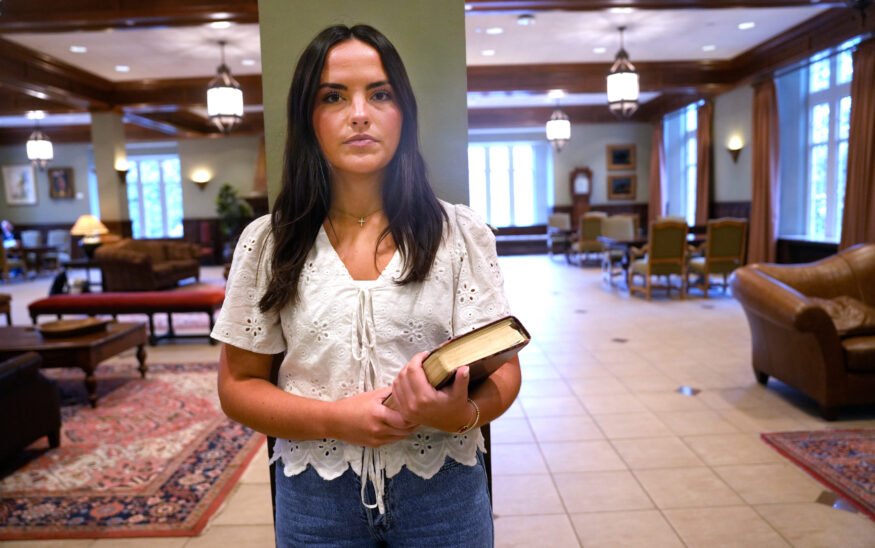
Samantha Fulnecky
The Assignment That Launched a Thousand Think Pieces
It started with a routine college assignment. Read a paper about gender norms. Write a response. Simple enough—except when your worldview collides head-on with your coursework, and you decide to make that collision go viral.
Samantha Fulnecky, a pre-med junior at the University of Oklahoma, didn’t just complete her assignment. She turned it into a manifesto about Christian values in secular academia, posted her zero-point grade online, and watched the internet explode.
Within hours, her story was everywhere. Conservative outlets hailed her as a martyr for religious freedom. Progressive academics rolled their eyes at another persecution complex. Social media fractured into opposing camps, each convinced they knew exactly what this incident meant for the future of higher education.
But here’s what makes this story fascinating: it’s not really about one student or one grade. It’s about the increasingly fraught intersection of personal belief and academic inquiry—and nobody seems to know where the boundaries should be.
The Student Who Wouldn’t Stay Silent
Samantha Fulnecky grew up in a world where faith wasn’t optional—it was foundational. Raised in a Christian household where biblical principles shaped everything from family structure to career choices, she learned early that belief should inform action. Not just on Sundays. Always.
When she decided to pursue pre-med, it wasn’t just about professional ambition. It was a calling—a way to serve others that aligned with her values. Medicine, in her view, was ministry. Healing was holy work. The science and the sacred weren’t separate; they were interwoven.
College was supposed to be where she’d gain the knowledge to fulfill that calling. But from the start, Fulnecky encountered a problem: her professors didn’t seem to share her worldview. In fact, much of her curriculum directly contradicted it.
Classes that presented gender as a social construct rather than a biological binary. Evolutionary biology taught as fact, not theory. Medical ethics discussions that didn’t factor in religious perspectives. For Fulnecky, each class became a battleground where she had to choose: comply and compromise, or resist and risk consequences.
She chose resistance. Not quietly, not privately, but publicly and deliberately. Because in her view, remaining silent would be betraying the very values that brought her to medicine in the first place.
That decision was about to cost her. And make her famous.
The Paper That Changed Everything
The assignment seemed straightforward: read a scholarly article about gender norms and write a response that engaged critically with the material.
Most students would have analyzed the methodology, discussed the implications, maybe questioned a few assumptions while staying within academic conventions. Safe. Predictable. Passable.
Fulnecky had other plans.
Her response paper didn’t just engage with the article—it rejected its fundamental premises from a biblical perspective. She argued that gender distinctions aren’t social constructs but divine design. That traditional gender roles aren’t oppressive but ordained. That any analysis of gender divorced from scriptural truth was building on sand.
She wasn’t trying to hide her beliefs or couch them in academic language. She was planting a flag: This is what I believe. This is non-negotiable. Grade accordingly.
The professor—or rather, the graduate assistant grading papers—did exactly that.
Zero out of 25 points. No partial credit. No feedback. Just a number that, in academic terms, might as well have been a flashing neon sign reading “UNACCEPTABLE.”
For most students, that would have been devastating and private. Fulnecky made it public.
She posted the assignment, the grade, and her interpretation of what it meant: religious discrimination in academia. Proof that universities punish students who won’t conform to progressive ideology. Evidence that Christian values have no place in secular education.
The response was immediate and explosive.

- MATERIALS – Synthetic Resin DIMENSIONS – 12.1″H X 6.4″W X 2″D
- INSPIRATIONAL – This cross is engraved with encouraging and inspirational words and phrases
- BEAUTIFUL DESIGN – This Cross Sculpture looks like Stone Pillars Stacked Rocks shape with engraving letters
Grade Zero, Attention Infinite
Let’s talk about that zero for a moment—because it’s doing a lot of work in this story.
On one hand, academic assignments have standards. You can’t just ignore the prompt and expect full credit. If the assignment asks you to analyze a text and you instead use it as a launching pad for theological argument, that’s… not analyzing the text. That’s something else entirely.
On the other hand, a zero with no explanation feels punitive. Even if the work was fundamentally off-base, shouldn’t there be feedback? Shouldn’t students understand why they failed so they can improve? A zero with no commentary doesn’t teach—it punishes.
The lack of feedback became a crucial detail in the viral narrative. It suggested the grader wasn’t trying to educate Fulnecky, just shut her down. That her perspective wasn’t just academically insufficient—it was unwelcome. Forbidden, even.
Enter the other character in this drama: William “Mel” Curth, the graduate teaching assistant who assigned the grade.
Curth uses they/them pronouns—a detail that became central to how different audiences interpreted this story. For Fulnecky’s supporters, it confirmed their suspicions: of course the non-binary TA targeted the Christian student. It fit perfectly into a narrative of LGBTQ+ activists punishing traditional believers.
For Curth’s defenders, the focus on their pronouns was a deliberate distraction—an attempt to make the story about identity politics rather than academic standards. They argued that Fulnecky simply didn’t complete the assignment properly, and bringing Curth’s gender identity into it was bad-faith character assassination.
Both sides had receipts. Both sides had talking points. Neither side seemed interested in considering that maybe—just maybe—this was more complicated than heroes and villains.
When the University Caught Fire (Metaphorically)
The University of Oklahoma suddenly found itself in the middle of a culture war it didn’t start and couldn’t control.
Students took sides immediately. On one side, religious students who’d felt increasingly marginalized in secular academia saw Fulnecky as a hero. Finally, someone was saying what they’d all been thinking: that faith-based perspectives aren’t just unwelcome—they’re actively punished. Message boards and group chats filled with similar stories of feeling forced to hide beliefs or water them down to pass classes.
On the other side, students argued this was exactly the kind of bad-faith engagement that undermines education. That Fulnecky wasn’t being graded on her beliefs but on her failure to meet assignment requirements. That crying persecution when you simply didn’t do the work is intellectually dishonest.
Faculty were equally divided. Some defended academic freedom—including the freedom to express religious perspectives. Others insisted that academic freedom doesn’t mean freedom from academic standards, and that faith-based arguments in scholarly work need to meet the same evidentiary requirements as any other claim.
The administration, caught in the crossfire, did what administrators do: issued a carefully worded statement saying absolutely nothing. They were “committed to fostering an environment where intellectual discourse thrives” while “upholding academic standards” and “respecting diverse perspectives.” Which satisfied no one, but at least didn’t make things actively worse.
Behind the scenes, though, things were messy. Curth was placed on administrative leave—officially for their own protection, though exactly what they were being protected from remained unclear. Faculty meetings became tense debates about grading policies and religious accommodation. Students organized competing petitions.
And through it all, Fulnecky’s story kept spreading, mutating as it went, picked up by outlets across the political spectrum and interpreted according to their preferred narratives.
The Social Media Amplification Machine
Here’s how a college grading dispute becomes a national controversy in 2024: social media discovers it.
Fulnecky’s initial post got traction in Christian student networks. Then conservative media personalities found it. Then it jumped to mainstream outlets. Then progressive commentators started pushing back. Then it became a trending topic. Then everyone had an opinion, whether they’d read the actual assignment or not.
Hashtags multiplied: #SamanthaFulnecky, #ChristianValuesInAcademia, #AcademicFreedom, #ReligiousDiscrimination. Each became a rallying point for competing interpretations of what had happened and what it meant.
The viral nature of the story did something interesting: it flattened all nuance. Complex questions about academic standards, religious expression, and pedagogical approaches got reduced to sound bites. You were either Team Samantha or Team University. Team Faith or Team Science. Team Persecution or Team Accountability.
Nobody wanted to hear that maybe both sides had valid points. That maybe this situation revealed genuine tensions in higher education that deserve thoughtful consideration rather than tribal warfare.
The quotes that circulated were predictably inflammatory. Fulnecky’s supporters called the grading “anti-Christian bigotry” and “thought policing.” Her critics called it “academic accountability” and accused her of “playing the victim.” Both narratives spread, both found audiences, neither engaged with the actual complexity.
And that amplification had real-world consequences. Curth received threats serious enough to warrant administrative leave. Fulnecky’s social media filled with both support and harassment. The university had to increase security. Faculty started self-censoring in class, worried that any misstep would become the next viral incident.
This is what happens when education becomes content. When complex pedagogical situations become culture war ammunition. When students, faculty, and administrators discover that their private academic disputes can become very public very quickly.

The Impossible Balance
Let’s sit with the uncomfortable truth at the heart of this controversy: there might not be a clean answer.
Academic freedom is supposed to protect the free exchange of ideas. Students should be able to explore different perspectives, including religious ones, without fear of punishment. That’s fundamental to education.
But academic freedom doesn’t mean anything goes. It doesn’t mean you can ignore assignment parameters and still expect credit. It doesn’t mean personal belief automatically trumps scholarly standards. Education requires some shared framework, some agreed-upon methods of inquiry and evidence.
The question is: where’s the line?
Can a student write a response to a gender studies paper from a biblical perspective and still meet academic standards? Maybe—if they engage with the actual article, acknowledge counterarguments, and present their position with intellectual rigor rather than just assertion.
Did Fulnecky do that? We don’t actually know, because the assignment hasn’t been publicly released in full. We have her framing of it, her supporters’ interpretation, and her critics’ assumptions. But the actual work? That remains largely unseen.
This matters because the controversy might not actually be about what we think it’s about. It might not be “religious student persecuted by woke university” or “entitled student fails to meet standards.” It might be “unclear assignment expectations met with insufficient feedback led to explosive misunderstanding.”
Which is way less satisfying as a narrative, but possibly more accurate.
The broader issue is real, though. Religious students at secular universities often do feel marginalized. They encounter curricula that implicitly or explicitly reject their worldviews. They hear professors treat religious belief as backwards or ignorant. They navigate environments where faith is seen as private hobby rather than legitimate lens for understanding the world.
At the same time, universities have a responsibility to teach students to think critically, engage with evidence, and consider perspectives beyond their own. They can’t simply affirm whatever students already believe. Education that never challenges you isn’t education—it’s confirmation.
Threading that needle—respecting religious students while maintaining academic rigor—is genuinely difficult. And neither side seems interested in acknowledging the difficulty.
What This Means for Everyone Else
The Fulnecky case is significant not because it’s unique, but because it’s increasingly common.
As universities become more ideologically homogeneous in certain ways, students whose views diverge from institutional norms feel more isolated and defensive. As political polarization intensifies, academic disputes become proxy battles in larger culture wars. As social media amplifies every controversy, stakes feel impossibly high.
This creates a chilling effect that hurts everyone. Religious students self-censor, worried that expressing their beliefs will tank their grades. Progressive students face harassment when their perspectives go viral. Faculty avoid controversial topics, knowing one complaint could become a national incident.
The result is an academic environment that’s supposed to encourage robust debate but increasingly rewards conformity and silence.
For religious students specifically, the message is clear: you can have faith, but keep it private. You can believe what you want, but don’t let it show up in your coursework. You can practice your religion, but not if it conflicts with academic orthodoxy.
That’s a problem—not because universities should uncritically affirm all religious perspectives, but because genuine intellectual diversity requires making space for worldviews that challenge institutional assumptions. Including religious ones.
At the same time, religious students need to grapple with the fact that higher education will challenge their beliefs. That’s the point. You’re supposed to encounter ideas that make you uncomfortable, perspectives that contradict what you’ve always known. If you emerge from college believing exactly what you did when you entered, you probably wasted your tuition.
The goal isn’t to lose your faith—it’s to develop a faith that can withstand scrutiny. That engages honestly with competing claims. That’s sophisticated enough to distinguish between core convictions and cultural Christianity.
But that kind of intellectual and spiritual growth requires an environment of genuine dialogue, not tribal warfare. It requires professors who challenge religious students fairly rather than dismissing them. It requires students who engage seriously with secular perspectives rather than just defending their positions.
Neither side seems very interested in that right now.
The Lessons Nobody Wants to Learn
So what should we take from the Fulnecky controversy?
First, that grading needs to be transparent. Whether Fulnecky’s assignment deserved a zero or not, she should have received clear feedback explaining why. The lack of explanation turned what might have been a teaching moment into a grievance. Universities need to ensure that grading rubrics are clear, feedback is substantive, and students understand how they’re being evaluated.
Second, that assignment design matters. If the goal was critical engagement with a text, that should have been explicitly stated. If students were free to respond from their own perspectives, that should have been clarified. Ambiguous assignments invite conflict.
Third, that social media is a terrible place to resolve academic disputes. Going viral doesn’t clarify truth—it just amplifies noise. Both students and universities need better mechanisms for addressing grievances before they become content.
Fourth, that we desperately need more nuance in how we discuss these conflicts. Not every grading dispute is religious persecution. Not every expression of faith in coursework is academically inappropriate. Sometimes situations are genuinely complex, and treating them as simple does everyone a disservice.
Fifth, that higher education needs to think seriously about how to accommodate religious diversity while maintaining academic standards. The current approach—which often amounts to “check your faith at the door”—isn’t working. Neither is the alternative extreme of “my religious beliefs exempt me from academic requirements.”
There’s a middle path. It requires good faith on all sides—professors who don’t dismiss religious perspectives out of hand, students who engage seriously with course material even when it challenges their beliefs, administrators who support genuine intellectual diversity rather than just paying lip service to it.
But finding that path requires something nobody seems willing to give: the benefit of the doubt.
Beyond the Binary
Here’s what gets lost in the Fulnecky story: the possibility that everyone involved was trying their best in a genuinely difficult situation.
Maybe Curth wasn’t targeting a Christian student but legitimately believed the work didn’t meet assignment requirements. Maybe they struggled with how to grade a paper that ignored the prompt in favor of theological argument. Maybe they gave a zero not out of malice but out of inexperience with how to handle such a situation.
Maybe Fulnecky wasn’t trying to manufacture outrage but genuinely felt cornered—like she had to choose between her faith and her education, and neither option was acceptable. Maybe posting about it wasn’t calculated martyrdom but a desperate attempt to be seen and understood.
Maybe the university wasn’t covering up discrimination or persecuting believers but genuinely trying to navigate an impossible situation where any action would anger someone.
Maybe everyone’s a human being doing their imperfect best in a system that’s not equipped to handle the increasing polarization of American society.
That’s not a satisfying narrative. It doesn’t have clear heroes or villains. It doesn’t offer simple solutions or validate anyone’s preferred worldview. It just suggests that this is hard, and we’re all stumbling through it, and grace might be more useful than certainty.
But grace is in short supply these days. Especially online, where nuance dies and outrage thrives.
So instead, we get the version where Samantha Fulnecky is either a courageous truth-teller standing against secular tyranny, or an entitled student playing the victim when held to basic standards. Where Mel Curth is either an unfair grader pushing an agenda, or a professional educator appropriately applying academic standards. Where the University of Oklahoma is either protecting academic freedom or suppressing religious expression.
All of which might be partially true. None of which is the whole story.
What Comes Next
The Fulnecky case won’t be the last. As American society continues to polarize, universities will face more of these conflicts. Students with strong religious convictions will continue to clash with secular academic norms. Faculty will continue to struggle with how to evaluate work that meets some criteria but fundamentally misses others. Administrators will continue to issue bland statements that satisfy no one.
Unless something changes.
Universities could start by acknowledging that religious students have legitimate concerns about feeling marginalized. Not as a concession that they’re being persecuted, but as recognition that the secular nature of modern academia can feel alienating to people of faith.
They could create clearer guidelines about how religious perspectives can be incorporated into academic work. Not “anything goes,” but genuine parameters that respect both academic standards and sincere belief.
They could train faculty—especially graduate TAs—in how to handle situations where students’ work reflects worldviews that differ from course content. How to grade fairly while maintaining standards. How to provide feedback that educates rather than condemns.
Religious students, meanwhile, could recognize that higher education will challenge them. That’s not persecution—it’s education. Being uncomfortable with course material isn’t the same as being discriminated against. Learning to engage with perspectives you disagree with is a crucial life skill, not an attack on your faith.
They could approach assignments in good faith—actually engaging with the material rather than treating coursework as an opportunity for apologetics. You can disagree with a text while still demonstrating that you understand it. You can maintain your beliefs while showing intellectual curiosity about alternatives.
Both sides could remember that the people on the other side are humans, not enemies. That someone who grades your paper poorly isn’t necessarily attacking your faith. That someone who expresses religious views in coursework isn’t necessarily being academically dishonest.
That grace, curiosity, and humility might be more productive than outrage, defensiveness, and certainty.
But that requires something rare and difficult: the willingness to be wrong. The openness to consider that maybe your interpretation isn’t complete. The intellectual and emotional flexibility to hold your convictions while genuinely engaging with alternatives.
And right now, in 2024, that’s asking a lot.
The Story We Keep Telling
The Samantha Fulnecky controversy will fade. Another viral incident will replace it. The cycle will continue.
But the underlying tensions won’t resolve themselves. Universities will remain caught between competing visions of their purpose. Students will continue to clash with curricula that challenge their beliefs. Faculty will keep struggling to balance academic standards with respect for diverse perspectives.
These are real problems without easy answers. They require thought, dialogue, experimentation, and grace. They require acknowledging complexity instead of reducing everything to culture war talking points.
They require us to be better than we’re being right now.
Maybe that’s the real lesson from this mess: not that one side is right and the other wrong, but that we’re all failing at something important. We’re failing to create educational spaces that genuinely welcome intellectual diversity. We’re failing to engage charitably with people whose beliefs differ from ours. We’re failing to distinguish between maintaining standards and enforcing conformity.
We’re failing to remember that education is supposed to expand understanding, not entrench divisions.
The Fulnecky case is a mirror. What you see in it probably says more about you than about what actually happened. If you see religious persecution, you’re revealing your concerns about faith in secular spaces. If you see entitled victimhood, you’re revealing your frustrations with bad-faith arguments cloaked in religious language.
Both revelations are legitimate. Both touch on real problems. Neither is the complete truth.
Maybe the real story isn’t about Samantha Fulnecky at all. Maybe it’s about us—about a society so polarized that we can’t even agree on what happened in a single college classroom, much less find a path forward that honors both rigorous inquiry and sincere belief.
That’s the controversy worth addressing. Not with viral posts and hot takes, but with the hard, unglamorous work of building better institutions and being better humans.
It’s not as satisfying as having someone to blame. But it might actually help.