India’s Religious Minorities Are Being Terrorized (And the World Is Finally Noticing)
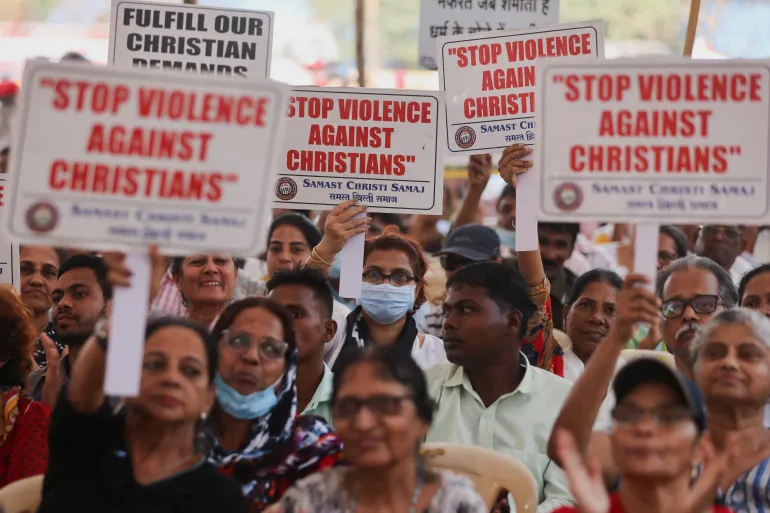
As hate spirals in India, Hindu extremists turn to Christian targets
When Hate Becomes Government Policy
India is the world’s largest democracy. A nation that gained independence through nonviolent resistance. A country whose constitution guarantees religious freedom and explicitly protects minority rights.
It’s also a country where, right now, churches are being burned, Muslims are being lynched, and the government led by Prime Minister Narendra Modi is doing essentially nothing to stop it—and in many cases, actively encouraging it.
Hindu nationalist mobs attack Christian prayer meetings, accusing worshippers of “forced conversions.” Police stand by and watch, sometimes joining in. Pastors get arrested. Churches get demolished. Christian families face social ostracism, economic boycotts, and physical violence.
Muslim men get beaten to death by mobs for the “crime” of transporting cows (considered sacred in Hinduism). Muslim neighborhoods face organized pogroms. Mosques get destroyed. Islamic culture and history get systematically erased from public spaces and school curricula.
And through it all, Modi’s Bharatiya Janata Party (BJP) government implements policies that institutionalize Hindu supremacy, pushes rhetoric that dehumanizes religious minorities, and creates legal frameworks that discriminate against non-Hindus—particularly Muslims.
This isn’t happening in secret. International human rights organizations are documenting it. Foreign governments are condemning it. The United Nations is calling it out. Global media is finally paying attention.
But inside India, for the Christians being terrorized and the Muslims being killed, international attention doesn’t stop the violence. It doesn’t protect their families. It doesn’t make their government care about their safety.
This is the story of how Hindu nationalism transformed from fringe ideology to governing philosophy in the world’s largest democracy—and what that transformation is doing to the 200+ million Indians who aren’t Hindu.
It’s also a story about how democracies can slide into majoritarian tyranny, how religious nationalism weaponizes state power against minorities, and why the international community’s response has been inadequate to stop the violence.
Welcome to Modi’s India, where being Christian or Muslim increasingly means living in fear.
The Historical Context You Need to Understand
India’s religious violence didn’t start with Modi. It has deep, bloody roots:
Partition (1947): When British India was divided into Hindu-majority India and Muslim-majority Pakistan, the resulting violence killed between 200,000 and 2 million people. Entire communities were massacred. Millions were displaced. The trauma shaped Hindu-Muslim relations for generations.
The legacy: Partition created narratives used by Hindu nationalists today—that Muslims are outsiders, that partition “proved” Hindus and Muslims can’t coexist, that India is fundamentally a Hindu nation from which Muslims carved out Pakistan.
Post-independence communal riots: India experienced periodic outbreaks of Hindu-Muslim violence throughout the decades following independence. Major riots in 1969, 1984, 1992-93, and 2002 killed thousands, mostly Muslims.
The pattern: Violence often followed provocations—disputed religious sites, inflammatory political rhetoric, rumors about minority communities. Police frequently failed to protect minorities or actively participated in violence.
The rise of Hindu nationalism: Organizations like the Rashtriya Swayamsevak Sangh (RSS)—founded in 1925—promoted Hindutva ideology: the idea that India is fundamentally a Hindu nation and that non-Hindus (particularly Muslims and Christians) are threats to Hindu identity and culture.
The trajectory: Hindu nationalist ideology moved from fringe to mainstream over decades, gaining political power through the BJP, which has explicit ties to the RSS.
The turning point: The 1992 demolition of Babri Masjid (a 16th-century mosque) by Hindu nationalist mobs, replaced by plans for a Hindu temple, became symbolic victory for Hindutva movement. The resulting riots killed thousands of Muslims.
Modi himself was Chief Minister of Gujarat during the 2002 riots that killed over 1,000 people (mostly Muslims). Critics accuse him of enabling or encouraging the violence. He’s never been held legally accountable, though the events follow him politically.
Understanding this history is crucial: Modi didn’t create Hindu nationalism or religious violence in India. But he brought Hindu nationalist ideology into the highest levels of government, normalized it, and gave it state power.
How Modi Changed Everything
When Modi became Prime Minister in 2014, Hindu nationalism went from political movement to governing philosophy. Here’s what changed:
Legal discrimination became policy:
The Citizenship Amendment Act (CAA) provides path to citizenship for religious minorities from neighboring countries—except Muslims. It’s the first time Indian law explicitly discriminates based on religion, violating constitutional secularism.
Anti-conversion laws in multiple BJP-governed states criminalize religious conversions, ostensibly to prevent “forced conversions” but used almost exclusively to target Christians and persecute those who convert from Hinduism.
Cow protection laws criminalize cattle slaughter and beef consumption in many states, providing legal cover for vigilante violence against Muslims (and Dalits) involved in cattle trade or accused of beef consumption.
The National Register of Citizens (NRC) threatens to render millions of Muslims stateless by requiring documentary proof of citizenship that many poor, marginalized people don’t possess.
Rhetoric normalized hate:
Modi and BJP leaders routinely use dehumanizing language about Muslims—calling them “infiltrators,” “termites,” suggesting they’re excessive breeders threatening Hindu demographic majority.
Government officials describe Christians as “foreign agents” engaging in “conspiracies” to convert Hindus, framing legitimate religious practice as national security threat.
The language creates permission structure: If minorities are threats, violence against them becomes defense of the nation and Hindu identity.
State power shields perpetrators:
Police rarely arrest Hindu nationalist attackers. When they do, charges often get dropped. Convictions are extremely rare.
Meanwhile, victims who defend themselves or report attacks face arrest, harassment, and prosecution.
The message is clear: The state protects Hindu nationalist violence and punishes minority resistance.
Media became propaganda:
Major Indian media outlets, many owned by Modi allies or dependent on government advertising revenue, either ignore minority persecution or frame it as minorities’ fault.
Coverage emphasizes Hindu grievances and perceived Muslim/Christian threats while minimizing or justifying violence against minorities.
Independent journalism investigating these issues faces harassment, tax raids, and accusations of being “anti-national.”
International pressure gets dismissed:
When foreign governments or international organizations criticize India’s treatment of minorities, Modi government responds with accusations of interference, colonialism, or anti-India bias.
Criticism gets reframed as attack on India itself rather than legitimate concern about human rights, making domestic audiences defensive and rallying nationalist sentiment.
The Violence Against Christians Nobody Talked About
While anti-Muslim violence gets more international attention (because it’s more widespread and deadly), Christians in India face escalating persecution that’s largely flown under global radar:
Church attacks: Churches burned, vandalized, forced to close. Christmas celebrations disrupted by mobs. Prayer meetings raided by police.
Pastors arrested: Charged with “forced conversions” for baptizing willing converts. Beaten by mobs while police watch. Some killed.
Social ostracism: Christian families boycotted economically—denied services, employment, access to community resources. Children bullied in schools.
Forced reconversions: Hindu nationalist groups conduct “ghar wapsi” (homecoming) ceremonies forcing or coercing Christians back to Hinduism.
Propaganda: Christians portrayed as foreign agents (because Christianity isn’t indigenous to India), accused of converting Hindus through fraud, coercion, or bribery.
The irony: India has ancient Christian communities—Christianity arrived in India in the 1st century CE, earlier than in most of Europe. Indian Christians aren’t “foreign”—they’re indigenous Indians who happen to be Christian.
The scale: Exact numbers are disputed, but Christian advocacy organizations document hundreds of attacks annually, with significant underreporting because victims fear retaliation or don’t trust authorities.
Why Christians? Several reasons:
- They’re easier targets than Muslims (smaller population, less political power, less likely to fight back)
- Conversion paranoia: Hindu nationalists obsess over Christians “stealing” Hindus through conversion
- They’re associated with the West, making them easy to frame as foreign agents
- They work among marginalized communities (Dalits, tribal peoples), threatening caste hierarchy
- Attacking them tests boundaries for what violence is tolerated before expanding to larger Muslim population
Christians are canaries in the coal mine—the violence against them signals broader acceptability of religious persecution.
The Violence Against Muslims That’s Impossible to Ignore
Anti-Muslim violence in Modi’s India is more extensive, more deadly, and increasingly systematic:
Lynchings: Muslim men beaten to death by mobs for allegedly possessing beef, transporting cows, or just being Muslim in the wrong place. Police often complicit or inactive.
Mob violence: Organized attacks on Muslim neighborhoods, businesses, mosques. The 2020 Delhi riots killed dozens (mostly Muslims) in coordinated violence while police largely stood by.
Demolitions: Muslim homes and businesses bulldozed by government authorities, often without proper legal process, targeting families of Muslim activists or those accused of crimes.
“Love jihad” harassment: Muslim men in relationships with Hindu women accused of conspiracies to seduce and convert Hindu women, facing violence and legal persecution under “anti-love jihad” laws.
Economic marginalization: Muslims face discrimination in employment, housing, education. Boycotts of Muslim businesses. Exclusion from economic opportunities.
Cultural erasure: Muslim historical sites demolished or “reclaimed” as Hindu sites. Islamic history removed from textbooks. Muslim contributions to Indian history minimized or erased.
Political disenfranchisement: Muslim political representation declining. Muslim concerns ignored. Muslim voters increasingly irrelevant to electoral math in Hindu nationalist politics.
The genocide question: Some analysts warn of genocide risk, pointing to: dehumanizing rhetoric, systematic discrimination, state complicity in violence, impunity for perpetrators, increasing organization of attacks. Others argue it hasn’t reached that level. But the warning signs are concerning.
Case Studies: When Hate Becomes Real
Abstract statistics don’t capture the human reality. Here are specific incidents:
Madhya Pradesh church attack (2023): Armed mob storms Sunday service. Beats worshippers. Destroys religious items. Accuses pastor of forced conversions. Police arrest the pastor, not the attackers. Congregation too afraid to return to church.
Karnataka pastor assault (2022): Pastor and family threatened, beaten by Hindu nationalist mob accusing him of converting Hindus. Police refuse to intervene. Pastor forced to flee town, abandoning his community.
Chhattisgarh Christian persecution (ongoing): Tribal Christians face systematic harassment—economic boycotts, social ostracism, violence, denial of government services. Villages pass resolutions banning Christianity. State largely ignores it.
Muslim lynchings (2015-present): Dozens of cases where Muslim men are beaten to death by mobs over cow-related accusations. Perpetrators often go unpunished. Some receive celebration and political support.
Delhi riots (2020): Organized violence against Muslims in India’s capital during Trump’s visit. Mosques destroyed. Muslim neighborhoods burned. At least 53 dead (mostly Muslim). Police accused of participating. Minimal accountability.
Babri Masjid to Ram Mandir (1992-2020): Hindu nationalists destroy 16th-century mosque, claim site for Hindu temple. Legal battle ends with court awarding site to Hindus. Modi lays foundation for new temple. Muslims get small plot elsewhere. Historical wrong “corrected” through demolition and legal sanction.
Each incident is a family destroyed. A community traumatized. A message sent: You’re not safe. The state won’t protect you. Violence against you is acceptable.
How Communities Respond (Survival and Resistance)
Religious minorities in India aren’t passive victims. They’re organizing, advocating, resisting:
Christian responses:
Interfaith alliances: Christians building coalitions with Muslims, Dalits, secular Hindus, and other marginalized groups for mutual support and advocacy.
Documentation: Churches and Christian organizations meticulously documenting attacks for legal cases and international advocacy.
Legal challenges: Fighting anti-conversion laws and persecution through courts, with mixed success.
Quiet resilience: Many churches operate with heightened security, lower profiles, preparing congregations for hostility while maintaining faith practice.
International advocacy: Leveraging global Christian networks to pressure Indian government and raise awareness internationally.
Muslim responses:
Civil society activism: Muslim organizations working on legal aid, documentation, advocacy, and community support for victims.
Political engagement: Despite marginalization, working within democratic system to influence policy and elections where possible.
Solidarity networks: Building connections across religious and caste lines to resist Hindu nationalist agenda.
Cultural preservation: Efforts to document and preserve Islamic heritage threatened by erasure and destruction.
International advocacy: Diaspora communities and international Muslim organizations raising awareness and pressure.
Shared challenges:
Both communities face: fear of retaliation for speaking out, distrust of authorities, limited legal recourse, international attention that’s insufficient to stop violence, exhaustion from constant vigilance, trauma affecting mental health and community cohesion.
Shared resilience:
Despite everything: communities maintain faith practices, support each other, refuse to be erased, keep advocating for rights, hold onto hope that India’s democratic and secular institutions can be revived.
The International Response (Too Little, Too Late?)
Global reaction to India’s treatment of religious minorities has been significant but insufficient:
United States:
U.S. Commission on International Religious Freedom (USCIRF) has recommended India be designated “Country of Particular Concern” for severe religious freedom violations. Recommendation ignored by State Department, which values India as strategic partner.
Congress members have raised concerns. Some have introduced resolutions. But U.S. government prioritizes strategic partnership with India over human rights pressure.
United Nations:
Special Rapporteurs have issued statements condemning violence, calling on India to protect minorities. India dismisses as interference.
Human Rights Council has received reports documenting persecution. Limited concrete action beyond statements.
European nations:
Various European governments have raised concerns, particularly about CAA and treatment of Muslims. Impact limited—India is important economic partner.
International human rights organizations:
Human Rights Watch, Amnesty International, others have documented violence, issued reports, called for accountability. India has harassed or expelled some of these organizations.
Why response is inadequate:
Strategic interests: India is important counterweight to China, major economy, democratic partner. Countries prioritize relationship over human rights pressure.
Economic ties: Trade and investment relationships make governments reluctant to push too hard on human rights.
India’s defensiveness: Government frames criticism as neo-colonialism or anti-India bias, making Western criticism counterproductive by rallying nationalist sentiment.
Competing global crises: Ukraine, Middle East, climate change, etc. compete for international attention and action.
Limited leverage: International community has few tools to pressure India—a large, important democracy that can resist external pressure more easily than smaller or authoritarian states.
The result: Lots of statements, reports, and expressions of concern. Minimal meaningful action to protect minorities or change Indian government behavior.
What Happens Next? (The Scenarios)
India’s trajectory on religious freedom could go several directions:
Scenario 1: Escalation
Hindu nationalism intensifies. Violence increases. Legal discrimination expands. India moves closer to Hindu rashtra (Hindu nation) with minorities as second-class citizens or worse. Democratic institutions continue eroding.
Likelihood: Moderate to high if BJP retains power and faces no significant domestic or international consequences.
Scenario 2: Political shift
Opposition parties unite, win elections, reverse discriminatory policies. Democratic and secular institutions strengthen. Minorities regain security and rights.
Likelihood: Low to moderate. Opposition is fragmented. BJP has significant support. Electoral math favors Hindu nationalist politics.
Scenario 3: Status quo
Current level of violence and discrimination continues without major escalation or improvement. Minorities live in ongoing precarity without full-scale pogrom or genocide.
Likelihood: Moderate to high. May be “equilibrium” where violence is bad enough to terrorize minorities but not bad enough to trigger major international intervention or domestic backlash.
Scenario 4: Grassroots change
Civil society movements, interfaith alliances, and resistance to Hindu nationalism build momentum. Cultural shift toward pluralism. Gradual improvement in minority conditions.
Likelihood: Low to moderate. Movements exist but face significant obstacles—state repression, media control, deep-seated prejudice.
Scenario 5: International pressure succeeds
Economic consequences, diplomatic isolation, or strategic costs force India to improve treatment of minorities.
Likelihood: Low. India is too important strategically and economically for severe international pressure.
Most likely outcome: Some combination of scenarios 1 and 3—slow escalation punctuated by high-profile violent incidents, ongoing discrimination, inadequate domestic and international response, minorities surviving but not thriving.
The Uncomfortable Questions
This crisis raises questions with no easy answers:
Can democracy protect minorities from majoritarian tyranny? India proves democratic institutions aren’t sufficient—you need commitment to pluralism, minority rights, rule of law. Without those, democracy can enable oppression by majority.
What’s the international community’s responsibility? Should countries prioritize human rights over strategic partnerships? How much pressure is appropriate? What interventions are effective vs. counterproductive?
How do minorities survive in hostile majority-rule systems? When democratic politics marginalizes you, state power targets you, and violence is tolerated against you—what strategies ensure survival and preserve dignity?
Is Hindu nationalism reversible? Once majoritarian ideology captures state power, can it be dislodged without major crisis? Or does it have to burn itself out?
What about Hindus who oppose this? Millions of Hindus reject Hindu nationalism. How do they build alternative vision? How do they resist without being labeled traitors?
Where’s the breaking point? What level of violence triggers serious international intervention? What domestic threshold causes political consequences for BJP?
The Conclusion Without Resolution
Religious minorities in India—Christians and Muslims primarily, but also Sikhs, Buddhists, Jains in some contexts—are living through escalating persecution under Modi’s Hindu nationalist government.
Churches burned. Muslims lynched. Discriminatory laws implemented. State power weaponized against minorities. Violence tolerated or encouraged. Democratic and secular institutions eroded.
International community expresses concern but takes minimal action. Strategic and economic interests override human rights priorities.
Minorities organize, resist, advocate, survive. But survival isn’t thriving. Living in constant fear isn’t living freely.
India—world’s largest democracy, nation that gained independence through nonviolent resistance, country with constitutional commitment to secularism and minority rights—is failing its religious minorities.
The trajectory is alarming. The human cost is enormous. The international response is inadequate.
And unless something changes—politically, socially, or through international pressure—the violence will continue, the discrimination will deepen, and India’s religious minorities will keep suffering.
What Can Actually Be Done?
For international community:
- Consistent diplomatic pressure prioritizing human rights alongside strategic interests
- Economic consequences for severe violations
- Support for Indian civil society defending minority rights
- Amplifying minority voices rather than speaking over them
- Refusing to legitimize discrimination through silence
For Indian citizens:
- Voting against Hindu nationalist parties
- Supporting interfaith initiatives and minority rights organizations
- Speaking out against violence and discrimination
- Documenting violations for accountability
- Building alternative vision of pluralistic India
For religious minorities:
- Continuing documentation and advocacy despite risks
- Building coalitions across religious and caste lines
- Leveraging international networks for pressure and support
- Maintaining communities and faith practice despite persecution
- Refusing to be erased
For global citizens:
- Educating ourselves about what’s happening
- Pressuring our governments to prioritize human rights in India policy
- Supporting organizations working on minority rights
- Amplifying minority voices and stories
- Not letting this disappear from international attention
None of this is sufficient. But it’s better than silence and complicity.
The Final Word (That Isn’t Final)
India’s religious minorities are being terrorized. The world is noticing. But noticing isn’t stopping the violence.
Christians face church attacks, arrests, social ostracism. Muslims face lynchings, pogroms, systematic discrimination. Both face a government that views them as threats rather than citizens deserving protection.
The largest democracy in the world is failing the democratic test: protecting minority rights against majority tyranny.
Until that changes, until minorities can practice their faith without fear, until the state protects rather than persecutes them—India’s claim to being a secular, democratic, pluralistic nation rings hollow.
The hate is spiraling. The violence is escalating. The international response is insufficient.
And religious minorities in India keep surviving, keep resisting, keep hoping—because what else can they do?
India’s religious minorities deserve better than survival. They deserve safety, equality, dignity, and full citizenship.
Until they have it, India’s democracy is a lie.
Key Takeaways:
- Hindu nationalism under Modi has intensified persecution of Christians and Muslims in India
- Violence includes church attacks, lynchings, mob violence, and state-sanctioned discrimination
- Legal frameworks now explicitly discriminate against religious minorities
- International response has been inadequate due to strategic interests
- Minorities are organizing and resisting despite significant risks
- India’s democratic and secular institutions are eroding under majoritarian rule
- The trajectory is alarming without significant domestic or international intervention
The world’s largest democracy is persecuting its religious minorities. We’re watching. We’re documenting. We’re not doing enough to stop it.
That has to change.